
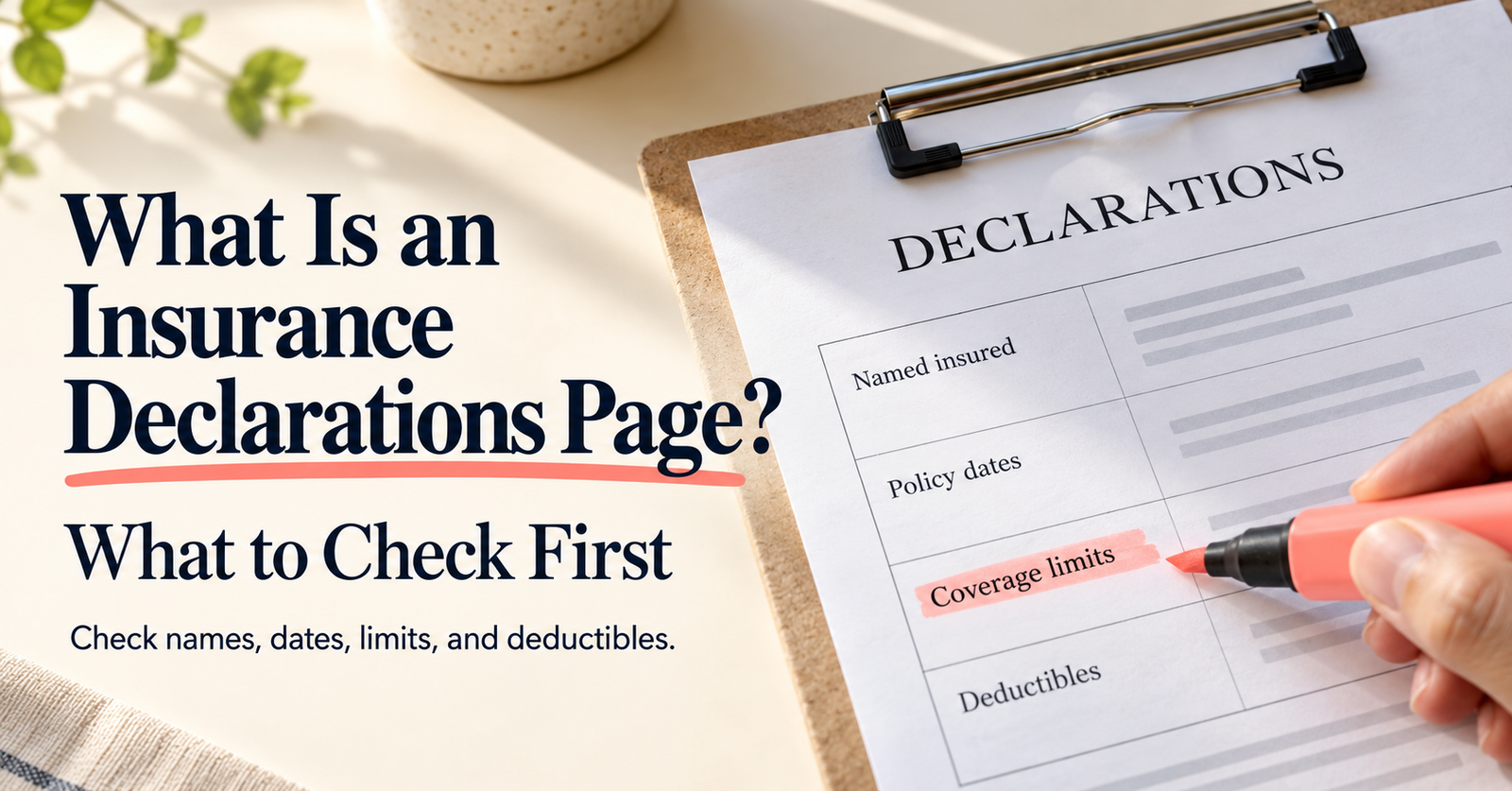
An insurance declarations page is a summary of important information about your policy. It commonly identifies the policyholder, insurer, policy dates, insured property or vehicles, coverage limits, deductibles, and premium.
You may hear it called a dec page, declarations, or policy declarations. Despite the name, it can be several pages long.
It is a useful place to begin when you want to understand what you bought. But it is not the entire policy, and it does not list every condition or exclusion that could affect a claim.
I like having a clear starting point for paperwork. With insurance, the declarations page provides that starting point, as long as you know which details need a closer look.
Where Do You Find Your Insurance Declarations Page?
Look in the documents section of your insurer’s website or app, your policy email, or the policy packet you received by mail.
Search for document names such as:
- Policy Declarations
- Declarations Page
- Renewal Declarations
- Policy Information
- Coverage Summary
If you cannot find it, ask your licensed agent or insurer for the current declarations and all applicable policy forms and endorsements.
Progressive’s explanation of insurance declarations pages notes that insurers may provide these documents electronically or by mail, and many make them available online. Access methods and document names vary.
Before reviewing the numbers, make sure you have the right version. An old renewal or a document issued before a coverage change may no longer describe your current policy.
If you are reviewing a past claim, ask for the documents applicable on the date of that loss.
What Should You Check First?
Begin with details you can verify without needing to understand every insurance term.
Your Name and the Named Insured
Check the spelling of the names and whether the policyholder information is correct.
The named insured is a person or entity specifically identified in that role. It does not necessarily mean every person who might qualify as insured under the policy will appear in the same place.
For example, household members may be addressed through definitions in the policy. Listed drivers, additional insureds, and excluded drivers can also have different roles.
Do not assume someone is covered simply because they live with you or appear somewhere in the paperwork. Ask the insurer to explain the applicable definition or endorsement.
The Property Address or Vehicle Information
For home or renters insurance, confirm the insured location, including an apartment or unit number.
The mailing address and insured property address may be different. Check both rather than assuming one correct address means everything is correct.
For auto insurance, compare the year, make, model, and vehicle identification number, or VIN, with the vehicle records. Also check any listed drivers and garaging information.
The NAIC’s auto insurance review guidance specifically recommends checking vehicle identification and lienholder information. Bring discrepancies to the agent or insurer promptly.
The Policy Dates
Find the effective date and expiration date. If an effective time is shown, check that too.
Do not assume an auto policy covers a full year. Read the term actually listed.
Also remember that a document showing a planned policy period does not override a later cancellation notice or prove the policy remains active today. If there is uncertainty, ask the insurer to confirm the current status.
Before replacing insurance, confirm when the new coverage actually takes effect. Do not cancel existing coverage based only on a quote or an unfinished application.
Check the Insurer’s Name, Not Just the Agency Name
The agency or agent who helped arrange a policy may be different from the insurance company issuing it.
The declarations commonly identify the insurer and may also provide the agent’s contact information.
Keep track of both. When you need to check coverage, billing, or a claim, knowing which company issued the policy helps you find the appropriate contact.
Missouri’s guide to understanding an auto insurance policy explains that declarations include identifying information, coverage details, costs, and dates. The rest of the policy supplies additional terms.
How Do You Read the Coverage Limits?
A coverage limit identifies the amount available under a particular coverage, subject to the policy’s terms.
A declarations page can show several limits because the policy covers different kinds of loss.
Do not treat the largest number as the amount available for every claim.
Home Insurance Limits
You may see separate amounts for:
- The dwelling.
- Other structures.
- Personal property.
- Loss of use or additional living expenses.
- Personal liability.
- Medical payments to others.
The dwelling amount concerns the home’s structure. The personal property amount concerns belongings. They serve different purposes.
Allstate’s sample homeowners declarations explanation shows how coverages, limits, deductibles, and personal property settlement information can appear. Your insurer’s layout may look different.
A listed limit does not establish that every loss involving that property is covered. You still need to check the covered causes of loss, exclusions, special limits, and settlement provisions.
Renters Insurance Limits
A renters policy generally focuses on belongings, liability, and other included protections rather than insuring the landlord’s building.
Check the personal property amount and how those belongings are valued after a covered loss. Then review any applicable special limits or endorsements.
Allstate’s renters declarations guide illustrates the location, premium, coverages, deductibles, and settlement information included in its documents. It is an example rather than a universal form.
Auto Insurance Limits and Coverages
Read the coverage section for each vehicle.
Do not assume every car on the policy has identical coverage or deductibles. One vehicle may have collision coverage while another does not.
Also check whether a limit applies per person, per accident, or under another stated rule. If you see shorthand numbers without understanding their meaning, ask the insurer to explain each one in dollars.
Allstate’s auto declarations example shows separate vehicle information and coverage details. A statement such as “full coverage” does not replace those specific entries.
Read Every Deductible, Including the Percentages
A deductible is the portion of a covered loss you bear under the applicable terms.
There may be more than one deductible listed. For home insurance, check for a separate wind or hail deductible. For auto insurance, comprehensive and collision may have different amounts.
If a deductible is a percentage, identify what amount it is calculated from.
For a hypothetical example, assume a home policy lists $300,000 in dwelling coverage and a wind or hail deductible equal to 2% of that amount:
$300,000 × 0.02 = $6,000.
That is not 2% of the repair bill.
My explanation of how home insurance deductibles work in actual dollars goes through the calculations and the difference between a deductible and your total out-of-pocket expense.
The purpose here is to identify the number before you need it. If the declarations do not make the calculation clear, ask for the relevant policy wording.
Check Whether Property Is Covered at Replacement Cost or Actual Cash Value
A coverage amount tells you one thing. The settlement method tells you another.
For home and renters policies, look for wording about replacement cost, actual cash value, or a personal property replacement cost endorsement.
Do not assume one settlement method applies to the house, roof, and belongings equally.
The NAIC’s homeowners and renters policy-reading guide recommends checking how property losses are settled and reviewing the endorsements. The declarations may identify the relevant coverage without explaining every requirement.
If you need the distinction explained, my article about replacement cost and the payment depreciation can change covers why replacement cost may still involve staged payments.
Compare the Premium for the Actual Policy Term
The premium is the cost of the insurance. It is separate from the coverage limit and deductible.
Check whether the amount shown applies to six months, a year, or another stated period.
For a hypothetical comparison, a $900 premium for six months and a $1,600 premium for twelve months cannot be compared as though they cover the same length of time.
Doubling $900 gives $1,800 for comparison purposes, but that is not a guarantee of the next renewal price.
Monthly installments also may not tell the whole story. Check the billing schedule, initial payment, installment fees, and total amount due for the term.
I want the comparison to answer a practical question: What does this coverage cost for the period shown, and what am I agreeing to pay after a covered loss?
What Are the Forms and Endorsements Listed Near the Bottom?
A declarations page may list document titles, form numbers, and edition dates.
These identify parts of the policy contract. They are worth reading even if they look like administrative codes.
An endorsement changes the policy. It can add coverage, change a limit, modify a settlement rule, or exclude certain losses.
The NAIC’s explanation of insurance endorsements and riders confirms that these documents can expand, modify, or restrict coverage. An endorsement is not automatically an extra benefit.
If your declarations list a form you do not have, request it. Ask what changed and when the change became effective.
What the Declarations Page Does Not Tell You
A short summary cannot answer every coverage question.
You may need the full policy to understand:
- Who qualifies as an insured.
- Which events are covered or excluded.
- Special limits for certain belongings or losses.
- Requirements for replacement cost payment.
- Duties after a loss.
- Restrictions involving property or vehicle use.
- How endorsements modify the original wording.
Progressive’s guide to reading the full insurance policy explains why the definitions, insuring agreements, exclusions, and conditions must be read alongside the declarations.
A useful question for your licensed agent or insurer is: “Where does the policy explain how this coverage applies to the situation I’m asking about?”
That gets you beyond a coverage label and into the provision that matters.
What Should You Do if Something Is Wrong?
Contact your agent or insurer and identify the discrepancy clearly.
Explain what the document says, what you believe is correct, and why. Ask whether the issue affects coverage and what documentation is needed.
For a requested correction or coverage change:
- Ask when it will become effective.
- Request written confirmation.
- Obtain the updated declarations or endorsement when issued.
- Check the revised document.
Do not edit your own copy and treat that as an insurance change. Do not assume a request has been accepted simply because you sent it.
If a claim has already happened, ask which documents applied on the loss date. Correcting information and changing coverage are different actions.
Common Questions About Insurance Declarations Pages
Is a declarations page the same as an insurance card?
No. An auto insurance card is a shorter identification document. The declarations provide more detail about purchased coverages, limits, deductibles, and premium. Use the document requested by the person or organization asking for proof.
Is a declarations page the same as a quote?
No. A quote describes proposed pricing and coverage. Policy declarations describe an issued policy’s details. Neither an old declarations document nor a proposed quote should be treated as confirmation that coverage is currently active.
Can a lender or landlord ask for the declarations page?
They may request declarations or another proof-of-insurance document. Ask exactly what is required and provide it through the appropriate channel. A landlord’s request also does not determine whether that landlord has any insured status under your policy.
Does every kind of insurance use the same declarations format?
No. This guide focuses on home, renters, and auto policies. Other products may use a policy schedule, information page, certificate, or different summary. Their terms and document structure need their own explanation.
What should I check when renewal documents arrive?
Compare the new documents with the prior version. Check the premium, coverage amounts, deductibles, listed property or vehicles, and forms or endorsements.
Keep the old version for your records, but use the current documents when reviewing today’s coverage. If something changed that you do not understand, ask for an explanation before assuming the renewal is identical.