
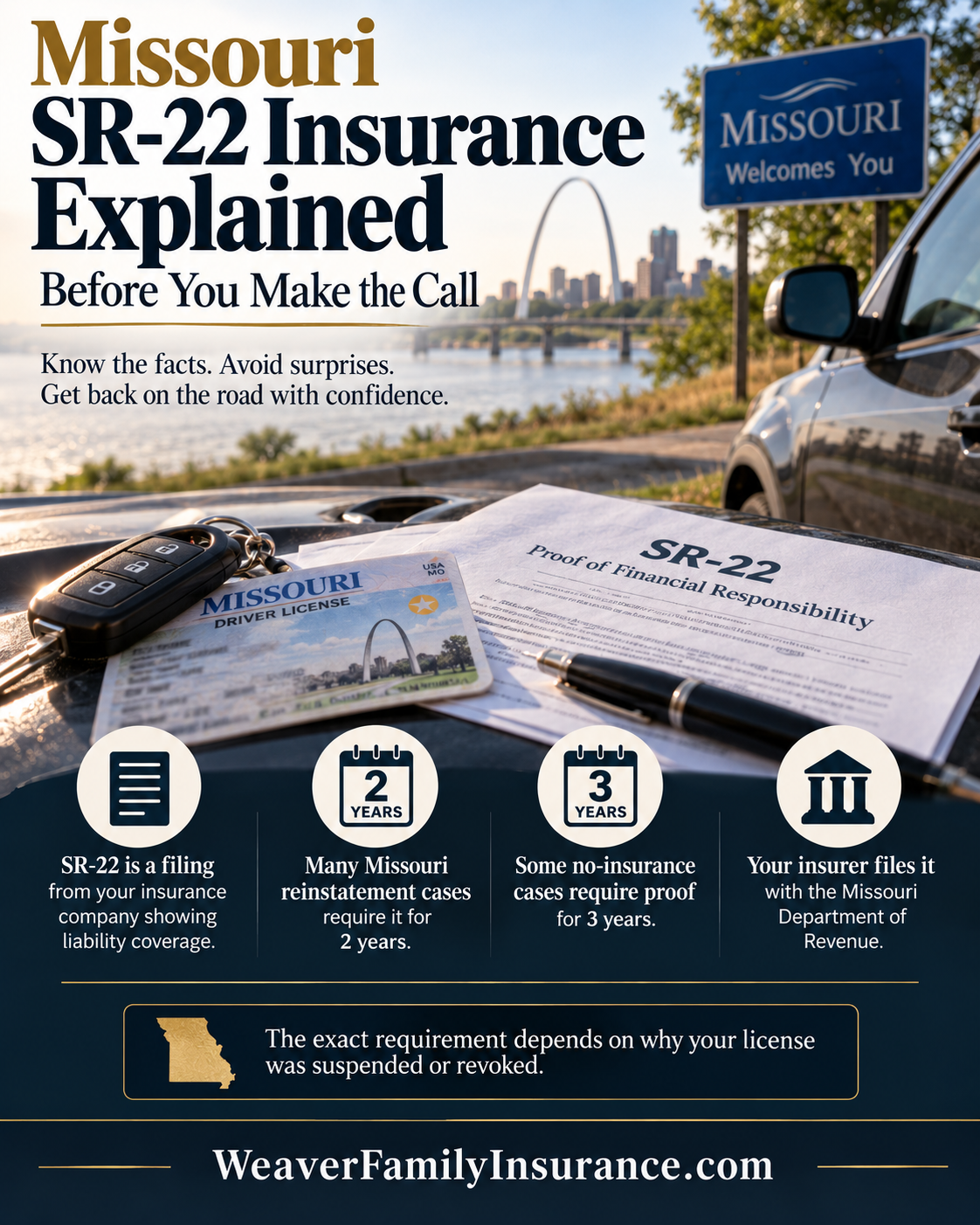
An SR-22 in Missouri is a form from an insurance company showing that you have the required liability insurance. It is a filing connected to insurance, rather than a separate type of policy.
People commonly call it “SR-22 insurance,” so that is the phrase you will see online. But there are two things to keep straight: the policy provides coverage, and the SR-22 provides the required proof.
The filing also does not automatically restore your driving privilege. You may have other requirements to complete before you can legally drive again.
I want to make this paperwork easier to understand without making promises the paperwork cannot deliver. The useful starting point is your Missouri notice, the reason for the requirement, and the dates that apply to you.
What Does an SR-22 Actually Do?
An SR-22 certifies liability insurance to the state.
Missouri’s mandatory insurance FAQs explain that the form comes from an insurance company. They also distinguish situations requiring an SR-22 from those where other proof may be accepted.
The filing is not the same as:
- An insurance quote.
- A normal insurance identification card.
- A driver license.
- A reinstatement approval.
- Collision or comprehensive coverage for your car.
That last distinction matters. An SR-22 requirement does not, by itself, add protection for repairs to your vehicle.
For the coverage behind the filing, my guide to Missouri’s minimum car insurance requirements explains liability, uninsured motorist coverage, and the separate question of protecting your own car.
How Do You Know Whether You Need an SR-22?
Start with your official suspension, revocation, or reinstatement information.
Do not assume every ticket requires an SR-22. Do not assume every suspension has the same requirements either.
Missouri’s reinstatement requirements page separates requirements by the reason the driving privilege was lost. Depending on the situation, proof of insurance may be only one item among fees, program completion, testing, or other conditions.
Before buying anything, confirm whether you need an SR-22 specifically and which state requires it.
If the notice is unclear, ask the Driver License Bureau:
- What action is on my record?
- What proof of insurance is required?
- When does the required period begin?
- What else must I complete?
- How can I verify that everything has been received?
Those questions help avoid paying for the wrong solution or assuming one completed step resolves the whole situation.
How Do You Get an SR-22 in Missouri?
Contact your current insurance company or a licensed insurance agent and explain that you need a Missouri SR-22 filing.
Ask whether the company offers the filing and whether your current policy can support it.
If you are shopping for a policy, mention the SR-22 requirement at the beginning. Not every insurer offers this service.
Progressive’s SR-22 explanation describes how an insurer can arrange the filing in connection with coverage. Its process illustrates one company’s approach, rather than guaranteeing another insurer’s availability or timing.
Explain Your Actual Vehicle Situation
Tell the licensed agent or insurer whether you own a vehicle, regularly use a household vehicle, or occasionally borrow cars.
Provide accurate information about the drivers, vehicles, and use involved. Do not describe yourself as someone who only occasionally borrows a car if you actually drive it every day.
The coverage needs to fit the real situation. Getting a form filed is not a reason to leave out important information.
Confirm the Filing and Coverage Dates
Before relying on the arrangement, ask:
- When does the insurance become effective?
- When will the SR-22 be submitted?
- How will submission be confirmed?
- How can I verify receipt with Missouri?
- What documents should I keep?
A statement that the form “will be filed” is different from confirmation that it has been submitted and received.
How Long Do You Need an SR-22 in Missouri?
There is no single filing period that applies to every Missouri driver. The reason for the requirement and the starting date both matter.
For example, Missouri’s tickets and points FAQs state that an SR-22 is required for two years from the effective date of a point suspension, revocation, or denial.
For a mandatory insurance suspension involving an accident, Missouri describes a three-year proof requirement measured from the eligible reinstatement date.
That difference is why an online statement such as “Missouri SR-22 always lasts three years” is too broad.
The Starting Date Deserves Its Own Question
Knowing the number of years is not enough if you count from the wrong date.
The date you purchased a policy, the date a suspension began, and the date you became eligible to reinstate can be different.
Ask the Driver License Bureau to confirm the start date and the date your filing obligation ends for your record. If more than one action applies, ask whether it changes those dates.
I would rather have that answer confirmed than rely on a calendar estimate based on a general article.
Does Filing an SR-22 Mean You Can Drive Again?
No. Insurance coverage and permission to drive are separate matters.
You may have insurance in place while your driving privilege is still suspended or revoked.
Before driving, confirm that the state has received the required items and that your driving privilege has been restored or an applicable restricted privilege has been granted.
A Limited Driving Privilege Has Its Own Rules
A limited driving privilege, sometimes called an LDP, is not unrestricted permission to drive.
Missouri’s limited driving privilege information explains eligibility, required documentation, and the order granting the privilege. It also states that dropping required SR-22 coverage before the LDP expires will cancel the LDP.
If you have an LDP, read the actual order. Confirm when and for what purposes you may drive, along with any additional conditions.
The insurer handles insurance. The state or court handles the driving authorization applicable to your situation.
Can You Get an SR-22 if You Do Not Own a Car?
You may be able to use a non-owner auto insurance policy with the required filing.
Non-owner coverage is designed for certain people who drive vehicles they do not own. It is not automatically the right fit for every person without a vehicle titled in their name.
Progressive’s non-owner insurance guide explains that regular use of a household member’s vehicle can call for a different arrangement. Coverage generally does not provide collision or comprehensive protection for the borrowed vehicle.
No Car Does Not Automatically Mean No Filing Requirement
Selling a car or temporarily not driving does not necessarily end an obligation on your driving record.
Ask the Driver License Bureau whether the requirement remains. Then explain your vehicle access to a licensed agent or insurer.
A useful question is:
“I do not own a car, but I use this vehicle this often. What policy arrangement fits that situation and can provide the required filing?”
That gives the insurer enough context to evaluate the arrangement honestly.
How Much Does Missouri SR-22 Insurance Cost?
Separate the costs before comparing prices.
You may be looking at:
- The insurance premium.
- A filing charge, if the insurer applies one.
- State reinstatement fees.
- Other requirements associated with the particular suspension or revocation.
There is no reliable universal total for every driver.
The premium can vary with the insurer, driving record, insurance history, vehicle, location, and coverage selected. A filing fee is not the price of the whole policy.
Compare the Total for the Same Policy Period
Ask what is due today and what the total cost will be for the stated term.
A small initial payment does not tell you the total premium. Check the number of installments and any payment fees.
Also confirm what coverage is included. Two quotes can have different liability limits, optional protections, and deductibles.
My explanation of what to check on your declarations page can help you identify those differences after a policy is issued.
I do not want “cheap” to become shorthand for “I am not sure what I bought.” The goal is an accurate comparison.
What Happens if the Required Insurance Lapses?
A lapse can put your driving privilege at risk again.
Missouri’s motor vehicle insurance information explains that failing to maintain required proof can result in another suspension. The steps needed to resolve it depend on the action involved.
Do not assume missing one payment is harmless because the filing was already made.
Keep track of renewal dates, payment notices, and any cancellation information. If something is uncertain, contact the insurer promptly and ask whether coverage and the filing are still active.
Can You Change Insurance Companies?
Changing companies may be possible, but coordinate both the coverage and filing.
Before canceling the old policy, confirm:
- The new insurer can provide the required Missouri filing.
- The replacement policy’s effective date.
- How the new filing will be submitted.
- Whether the state needs anything else to maintain continuous proof.
An ordinary replacement policy without the necessary filing may not meet the obligation.
What Should You Do When the Required Period Ends?
Confirm with the Driver License Bureau that the filing is no longer required before asking the insurer to remove it.
Do not assume the requirement disappears from the policy automatically.
Removing an SR-22 filing is different from canceling auto insurance. If you continue owning or operating a vehicle, applicable insurance requirements still matter.
Keep confirmation of the completed filing period along with your current policy documents.
Other Missouri SR-22 Questions
Can I use my normal insurance card instead?
Sometimes Missouri accepts an insurance identification card for particular proof requirements. When an SR-22 is specifically required, do not assume the card substitutes for it. Follow the instructions for your action and confirm any uncertainty with the Driver License Bureau.
Does an SR-22 erase the ticket or suspension from my record?
No. It supplies proof of insurance. It does not erase the event that created the requirement or automatically complete the other reinstatement steps.
Can I buy an SR-22 without insurance behind it?
The filing certifies insurance coverage. Treat it as part of arranging the required policy and proof, rather than a standalone document you purchase to bypass insurance.
What if I move out of Missouri?
Do not assume moving ends a Missouri filing obligation. Ask Missouri whether the requirement continues, and tell the insurer where you now live and which state requires the filing. The company needs to confirm it can handle the arrangement.
What should I have ready before calling an insurer?
Have your official notice, the state requiring the filing, and a clear explanation of whether you own or regularly use a vehicle.
Ask about coverage, filing timing, total cost, and confirmation. Then check your driving status separately with the state before getting behind the wheel.